We also perform custom analyses and develop custom agentic AI pipelines to accelerate your preclinical drug development, biomarker identification, and data analysis.
Does the public evidence explain why some patients responded to prexasertib?
Twelve of 39 evaluable patients responded. This report works the public evidence for what separates them. Five candidate markers were assessed: a DNA-replication RNA score and POLA1 remain candidates, the evidence for CCNE1 was not supportive in either study, and two on-treatment readouts measure change after dosing starts. None has independent validation, and the report names the evidence that would test each.
What each section found
Prepared 2026-07-17 · from public evidenceFindings cite their sources
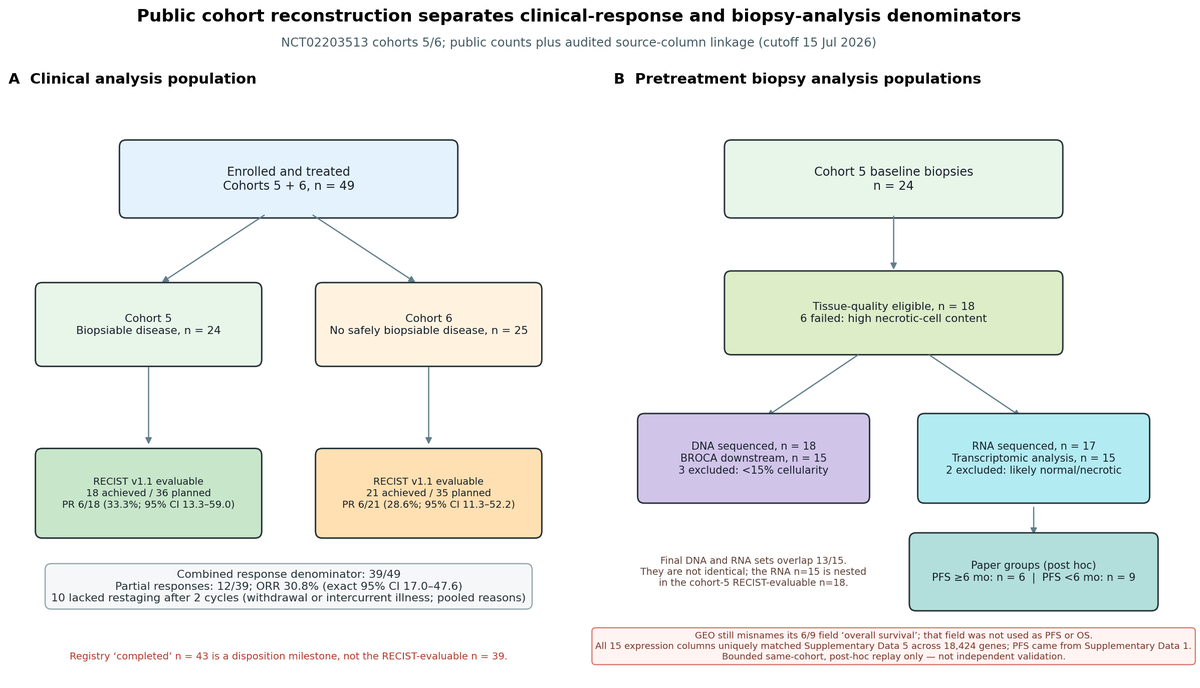
Figure 1. Public cohort reconstruction separates the clinical-response and biopsy-analysis denominators. The registry “completed” n = 43 is a disposition milestone, not the RECIST-evaluable n = 39 [PMID 38555285].
Forty-nine participants were treated, 39 were RECIST-evaluable, and 12 had a partial response. The signal-seeking study ended before its planned evaluable denominators were reached [NCT02203513]. Only 24 participants had baseline biopsies, 17 had RNA sequencing, and 15 entered the post-hoc transcriptomic analysis [PMID 38555285].
Endpoint and denominator finding
clinical-01 · high. A real activity signal exists, but early-stopped cohorts and mixed analysis denominators do not establish a clean efficacy result; the larger NCT03414047 provides lower external single-arm context and no significant genomic-response biomarker.
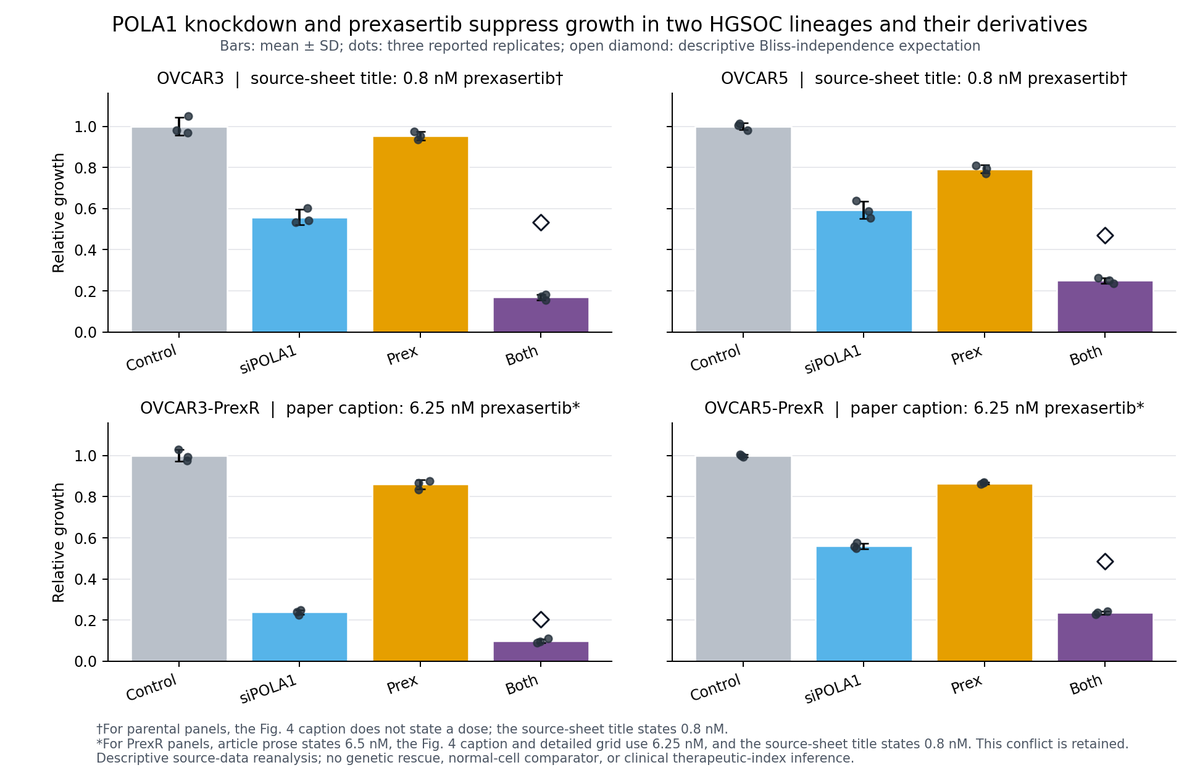
Figure 2. POLA1 knockdown plus prexasertib in two HGSOC lineages and their acquired-resistant derivatives; the open diamond is a descriptive Bliss reference, not formal synergy [PMC10981752].
Two candidates come out of the mechanism, and neither has been validated for patient selection. The published KEGG DNA-replication enrichment can be reproduced, but the patient-level replication signal is not robust across prespecified score definitions in the same 15 biopsies [GSE249587]. POLA1 remains a testable mechanism hypothesis, but the ST1926 source-data experiments do not prove POLA1-mediated combination benefit [PMC10981752].
Biomarker evidence
biomarker-01 · high. No public biomarker establishes clinical validity, predictive utility, or a patient-selection threshold. Research assays exist, but locked transfer, QC, precision, and clinical-use thresholds are absent.
Table 2. Candidate biomarkers by role and evidence state
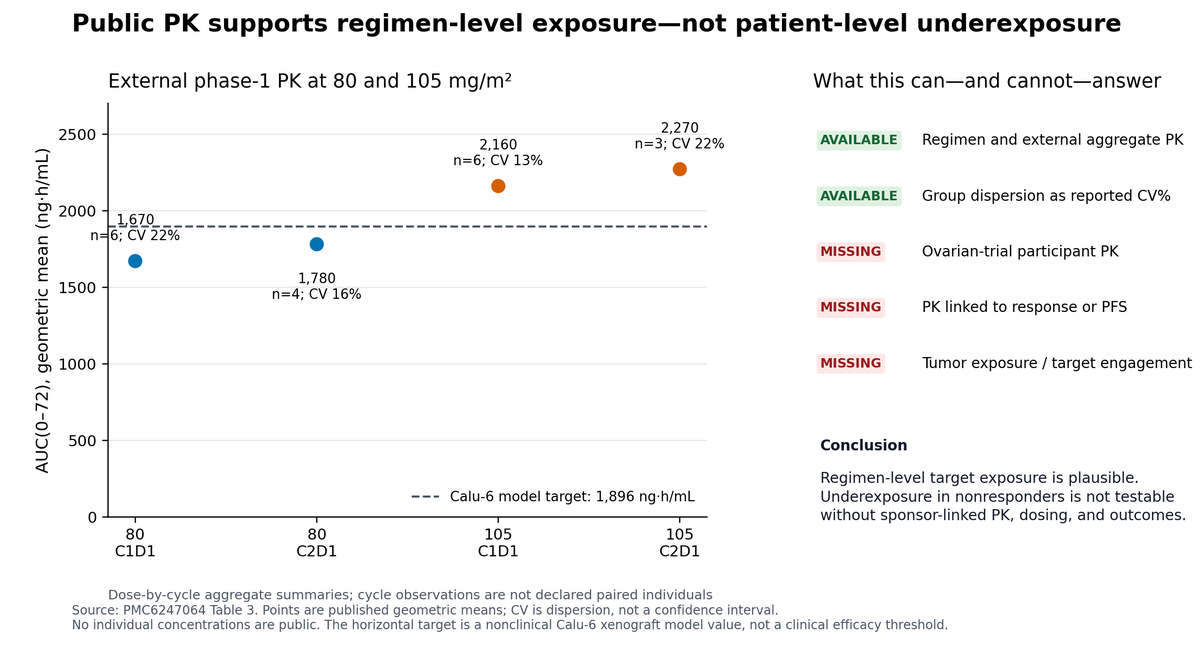
Figure 3. Public aggregate PK can bound gross underexposure. It cannot resolve individual exposure-response, tumor concentration, or CHK1 occupancy [PMC6247064].
Public aggregate PK makes gross regimen underexposure less likely [PMC6247064], but it cannot test whether individual nonresponders had lower exposure. None of the baseline markers directly measures CHK1 occupancy; C1D15 CTC and on-treatment pharmacodynamic readouts were not linked to individual outcomes in the public record.
Exposure–response evidence
exposure-01 · high. Public aggregate PK cannot link exposure to outcome [PMC6247064]. Participant-level concentrations tied to response, with prespecified covariates and assay and model diagnostics, would show whether nonresponders were underexposed.
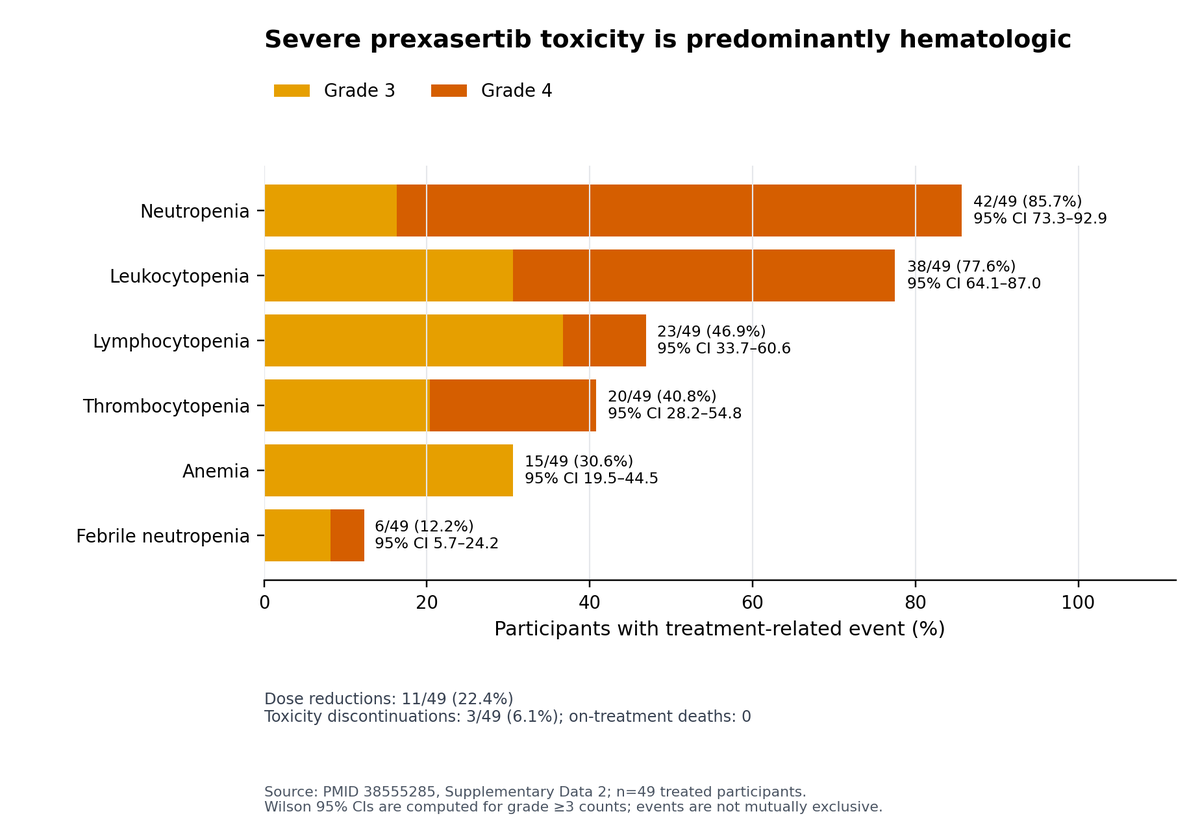
Figure 4. Severe prexasertib toxicity is predominantly hematologic: neutropenia 42/49 (85.7%; 95% CI 73.3–92.9), with dose reductions in 22.4% and no on-treatment deaths [PMID 38555285].
Prexasertib has a prominent, monitorable hematologic toxicity burden, while the safety window for a POLA1-directed combination is unknown. Grade 3–4 neutropenia is consistently the dose-limiting toxicity across reported datasets, but no exposure-normalized tumor-versus-marrow margin can be frozen from the public record.
Combination safety window
safety-01 · high. The public record sets no exposure-normalized tumor-versus-marrow/GI margin for a POLA1-directed combination [PMID 38555285][PMC6247064][PMC10981752]. Tumor and normal proliferative-cell data, read against a margin fixed in advance, would show whether one exists.
Table 4. Grade 3–4 treatment-related events in 49 treated participants
A responder subset makes a selection biomarker plausible. These are the candidates the public evidence raises, the evidence behind each, and the data that would show whether it predicts response.
Evidence that would resolve each open question
Candidate
Evidence state
Evidence that would resolve it
DNA-replication RNA score
unstable across score definitions
A frozen continuous score with fixed assay and QC tested blind in an independent cohort.
POLA1 dependence
unproven mechanism
Reproducible interaction across lineages with genetic rescue and target engagement.
Exposure–response
not linked to outcome
Participant-linked concentration–time tied to who responded.
The evidence that would separate signal from artifact
NCT03414047 is an independent prexasertib cohort. Its archived baseline tissue with linked outcomes, scored blind to outcome with a frozen continuous DNA-replication score and a fixed assay/QC procedure, would separate a real selection marker from a same-cohort artifact [NCT03414047].
Public patent landscape
ip-01 · medium. Public patent families touch the compound, salt/form, and response-predictive biomarker paths. This is a public-record landscape, not a legal or freedom-to-operate opinion. Eli Lilly filed the compound and salt families [WO2010077758A1][US10189818B2]; Acrivon filed the response-predictive biomarker method [WO2024015484A2].
Generated by DrugAdopt · not medical adviceGaps
Example DrugAdopt readout: prexasertib in platinum-resistant ovarian cancer. Open the full report →
We are taking on a small number of pilot assets. Most of the work runs on public evidence alone. Data you share for a DrugAdopt pilot stays on private cloud infrastructure and is not sent to public or third-party model APIs. How your data is handled.